
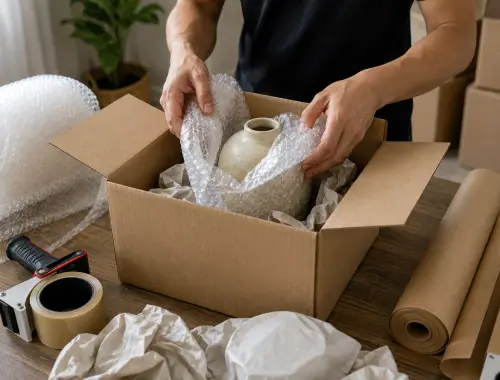
Packing Tips for a Smoother Move
Choose boxes that suit their contents, close them securely and label them clearly so your belongings are easier to identify and ready before the moving team arrives.
Choose the Right Box for the Load
Use the smallest practical box for dense belongings and reserve larger cartons for lighter, bulkier contents. A box does not need to be filled to its limit if the result is awkward or unstable.
- Pack books, crockery and other dense contents in smaller boxes.
- Use larger cartons for linen, cushions and lightweight bulky items.
- Replace damp, crushed, torn or weakened boxes before packing.
- Divide a difficult load into two smaller boxes rather than forcing one heavy carton.
There is no single maximum box weight that suits every person and situation. The practical test is whether the sealed box stays stable and can be controlled without its base, sides or handles failing.
Small box
Books and dense items
Medium box
Mixed household items
Large box
Linen and light bulky items
Make Every Box Secure Before It Moves
Strong cartons work best when the base is properly formed, the contents are balanced and the top closes flat without bulging.
1
Build
Start with a clean, dry box in sound condition. Fold the base correctly and tape the centre seam and joining edges securely.
2
Fill
Distribute weight evenly. Fill unused spaces with suitable cushioning so the contents do not move excessively inside the carton.
3
Seal
Close the top flaps flat and tape the full seam. Avoid open-top, overflowing or loosely folded boxes that can release their contents.
Pack Fragile Items to Limit Movement
Fragile contents need more than a warning label. Each piece should be supported so hard surfaces do not knock together and empty spaces do not allow movement inside the box.
Wrap • Cushion • Separate
Keep breakable surfaces supported and reduce movement inside the carton.
- Wrap breakable pieces individually where practical.
- Add cushioning to the bottom, sides and top of the box.
- Keep heavier pieces below lighter pieces.
- Fill gaps without forcing pressure onto delicate contents.
- Close the carton fully and identify it as fragile.
Discuss unusual items first
High-value, unusually fragile, unstable or specialist items may need separate assessment. A fragile label does not make unsuitable packing safe or confirm that every item can be handled as an ordinary box.
Use Labels That Help at Both Addresses
Write enough information for the box to be recognised quickly. Place the label on more than one visible side where practical so it can still be read when cartons are stacked.
Destination room
Kitchen
Use the destination room, not only the room where the box was packed.
Contents
Everyday plates
Prefer a short useful description over labels such as “miscellaneous.”
Box number
4 of 8
A simple sequence makes it easier to notice when a carton is missing.
Handling note
Fragile
Use notes such as fragile, upright or open first only where relevant.
Keep Hardware and Cables Organised
Furniture fittings and device accessories are easy to misplace when they are left loose. Labelled groups make it clearer which parts belong together at the destination.
Furniture hardware
- Place screws, bolts, brackets and fittings in sealed bags.
- Write the furniture item and destination room on each bag.
- Keep assembly instructions with the matching hardware.
- Take reference photographs before complex disassembly where useful.
Cables, remotes and accessories
- Label which device each lead, adapter or remote belongs to.
- Coil cables without forcing sharp bends or leaving them trailing.
- Group stands, controls and removable parts in labelled containers.
- Photograph complicated connections before disconnecting equipment.
Separate assessment
Check Before Packing Specialist Items
General moving-box guidance may not suit belongings that are unusually valuable, delicate, heavy, unstable or hazardous. Describe these items before assuming ordinary packing and handling will be suitable.
01
High-value possessions
Provide clear item details and photographs for review.
02
Artwork and antiques
Do not assume ordinary cartons or materials are appropriate.
03
Large glass pieces
Measurements, construction and access need to be considered.
04
Delicate electronics
Use suitable packaging and disclose fragile or detachable parts.
05
Unusually heavy items
Share the dimensions, known weight and handling requirements.
06
Hazardous or leaking contents
Do not place unsafe, leaking or unstable substances in ordinary moving boxes.
Before You Call a Box Finished
Complete this box-level check before moving on to the next carton. The broader access, appliance and moving-day tasks belong in the full Moving Preparation Checklist.
- The base is assembled and taped securely.
- The contents do not move excessively.
- The carton stays stable without bulging.
- The top closes flat and the seam is taped.
- The destination room is easy to see.
- The contents and box number are recorded.
- Fragile or orientation notes are visible.
- No loose hardware, cables or small parts remain unlabelled.
Packing Tips FAQs
These answers cover ordinary self-packing decisions. Specialist items and requested packing assistance still need to be discussed for the individual job.
There is no universal maximum that suits every box, person or access path. Use smaller cartons for dense contents and divide any box that becomes unstable, difficult to control or likely to fail at the base or sides.
Match the box size to the density of the contents, reinforce the base, fill unused space, close the top flat and tape the seams. Label the destination room, a short contents description, the box number and any relevant handling note.
Tell the team about unusually valuable, heavy, fragile, unstable, hazardous or specialist belongings before assuming ordinary packing is suitable. Artwork, antiques, large glass, delicate electronics and specialist equipment may need item-specific information and review.
Continue preparing
Related Moving Guidance
Use the guide or service page that matches the next part of your preparation.
Packing & Unpacking Services
See packing support that may be arranged in advance for the job.
Furniture Wrapping Services
See when furniture wrapping should be discussed before moving day.
Moving Preparation Checklist
Check inventory, appliance, access and arrival-readiness tasks.
Need Help With the Packing?
Tell the team what needs packing, which materials may be required and whether fragile-item packing, furniture wrapping or unpacking assistance should be considered. Packing support must be discussed and arranged in advance.