
Disability Equipment Delivery in Brisbane
Disability equipment delivery should start with the exact equipment model, transport dimensions, weight, battery details and the complete access path. Those details help determine whether the item can be collected, loaded and delivered using the available moving setup without guessing about its configuration.
Small Load Removalist provides pre-booked physical collection and delivery by arrangement. Model-specific preparation, technical isolation, installation, calibration, clinical setup and passenger transport remain the responsibility of the appropriate supplier, technician or healthcare professional.
✓
Two-Person Moving Team
✓
5-Ton Tailgate Truck
✓
Pre-Booked By Arrangement
Physical Delivery For Disability
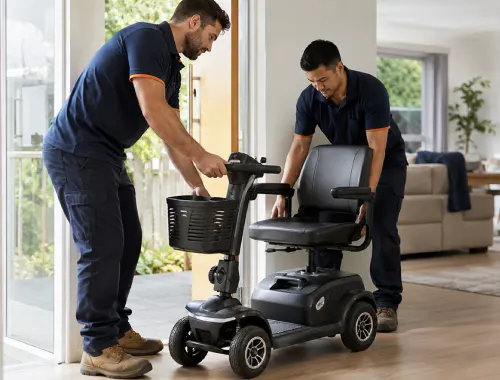
The standard setup uses two removalists and one 5-ton truck. See the moving equipment and suitability checks.
Items, access, route and preparation are reviewed before a pricing arrangement is offered. Read how quotes are assessed.
A Certificate of Currency is available on request. Cover is subject to terms and exclusions. Read the insurance policy.
Equipment delivery starts with the exact item
Tell us whether the job involves a wheelchair, scooter, hoist or another item of existing equipment. Provide the make, model, prepared dimensions and stated weight where known. If information is missing, send a clear equipment-label photo or supplier details rather than guessing.
The existing responsibility guide explains the customer, supplier, technician and moving team roles. This is physical delivery of suitable, unoccupied equipment. For a hospital bed as the main item, use our hospital bed transport assessment.
Before Collection
The Details That Shape Equipment Delivery
Four early checks help establish whether the item, collection point and destination can be assessed properly.
Exact Equipment Model
Provide the manufacturer, model name or number, and any available specification sheet or user manual.
Complete Item Size
Supply overall dimensions and weight in the transport configuration, including attached components that increase width, height or length.
Prepared For Movement
Confirm how batteries, controls, supports and detachable parts should be secured, removed or protected under the manufacturer’s instructions.
Release And Access
The supplier or collection contact must authorise release, while the receiving path and final room must be accessible.
When Disability Equipment Delivery May Be Suitable
This service may suit customers, families, suppliers or authorised organisers who need a mobility or assistive item physically collected and delivered between agreed addresses. Items we can assess include manual or powered wheelchairs, mobility scooters, portable hoists and electric adjustable beds. Each item must be checked against its exact model, transport configuration, weight, truck access and available handling equipment. Electric beds and hoists may require specialist preparation by the supplier or a qualified technician before collection.
Suitability depends on the exact item, its transport configuration, weight, packaging, battery condition, collection arrangements and the complete path into the destination room. Large, unusually heavy, fragile, damaged or technically complex equipment requires individual review before acceptance or booking.
Useful Situations To Discuss
- Supplier-to-home equipment delivery
- Home-to-home equipment relocation
- Collection from an agreed facility
- Delivery into a nominated room
- Equipment with removable components
- Jobs needing access measurement review
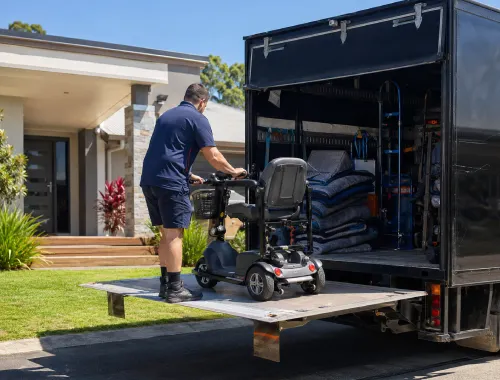
Physical Delivery For Disability And Mobility Equipment
Disability Equipment Delivery covers the physical collection, loading, road transport, unloading and agreed placement of suitable disability-related or mobility equipment. Depending on the item, the work may involve securing packaged equipment, protecting exposed surfaces, managing detachable components and moving the equipment through doorways, corridors, lifts or other access points. Small Load Removalist uses a two-person moving team and a 5-ton truck with a tailgate lifter, subject to the equipment being suitable for that setup.
The service is assessed as equipment transport, not as clinical or technical support. The owner, supplier or responsible technician must provide any model-specific preparation, battery isolation, specialist dismantling, configuration changes or post-delivery setup that falls outside ordinary physical moving. Installation, calibration, commissioning, medical advice, passenger transport and personal assistance are not included. When requirements are unclear, the team will review the available specifications, photographs and access details before confirming whether the job can proceed.
Assessment Factors
What Affects The Moving Arrangement
Each delivery is planned around the equipment’s physical characteristics and the conditions at both addresses.
1
Transport Configuration
The team needs the dimensions and weight of the item as it will actually be collected, not only its in-use specification.
2
Battery Type And Condition
Identify the battery type, whether it is removable and whether there is any visible damage or abnormal condition. Any model-specific battery preparation should follow the manufacturer or supplier instructions for that exact equipment.
3
Detachable Components
Controls, supports, cushions, trays, footrests or other removable parts may need separate securing and clear labelling.
4
Packaging Condition
Original cartons, transport frames, covers or protective packaging should be identified, including any damaged or incomplete packaging.
5
Collection Release
Supplier authorisation, collection contact details, opening times and any release documents must be confirmed before travel.
6
Destination Route
Door widths, lift dimensions, turns, corridors, steps and room access determine whether the equipment can reach the requested position.
From Enquiry To Delivery
A Six-Step Equipment Delivery Process
The process begins with technical item information and ends with physical delivery under the agreed moving arrangement.
Share Equipment Details
Send the manufacturer, exact model, photographs, overall dimensions, weight and information about batteries or detachable components.
Confirm Both Addresses
Provide collection and delivery details, parking conditions, carrying distances, stairs, lifts, doorways and the intended destination room.
Clarify Preparation Roles
Confirm what the supplier, technician or owner will prepare, isolate, detach, package or authorise before collection.
Receive Job Assessment
The team reviews item suitability, access, route, moving equipment requirements, scheduling and the appropriate pricing arrangement.
Arrange The Booking
Once the quote is accepted and any required booking or deposit steps are completed, the agreed moving date or time period can be confirmed.
Collect And Deliver
The team completes the agreed physical collection, transport, unloading and placement without undertaking technical installation or clinical setup.
← Equipment Delivery Guide
Planning A Disability Equipment Delivery
The Disability Equipment Delivery video explains the practical information needed before a delivery can be assessed, including equipment identification, transport dimensions, battery details, detachable components, collection authority and the access path into the receiving room.
- Finding the model specification
- Checking transport dimensions and weight
- Preparing batteries and removable parts
- Measuring the destination access path
A Delivery Plan Built From Known Details
Small Load Removalist assesses the actual equipment rather than treating every mobility or assistive item as interchangeable. A model name alone may not reveal the transport width, fitted accessories, battery arrangement or detachable components. Requesting specifications, photographs and the collection configuration gives the team a clearer basis for deciding whether the item suits the available truck, tailgate lifter and two-person moving setup.
The moving team normally carries blankets, tie-down straps, trolleys and four-wheel dollies. These are practical moving tools, but their suitability still depends on the equipment’s design, weight, balance, lifting points and packaging. The team does not infer clinical handling instructions or technical dismantling procedures. Where manufacturer guidance assigns preparation to an authorised provider or technician, that responsibility remains separate from the physical delivery.
Collection coordination is reviewed before the booking. A supplier, warehouse, residence, office or other agreed collection point may have its own release requirements, opening times or authorised contact. Confirming that the equipment is ready, correctly identified and approved for release reduces the risk of an unsuccessful collection. The destination contact should also know the intended room and provide access information before the team arrives.
Quoting is job-specific. The team considers the equipment, addresses, route, access, preparation, packaging and expected labour before recommending a fixed-price, hourly or other suitable arrangement. A fixed-price request is manually reviewed and does not create an automatic price or confirmed booking. Complete information helps the quote reflect the known work and makes any limitations clear before the delivery is scheduled.
Customer Feedback
Moving Feedback
Read feedback displayed through the Small Load Removalist Google profile about customers’ experiences across the business’s moving and delivery services.


 Trustindex verifies that the original source of the review is Google.
Owner's reply
It’s fantastic to hear the service exceeded your expectations, Sam. We’re pleased our team arrived on time, provided great value and put in the extra effort to make your move run smoothly. Thank you for choosing Small Load Removalist and for recommending our removalist service. We truly appreciate your support and would be glad to help with your next move across Brisbane, Moreton Bay or the Sunshine Coast.
 Trustindex verifies that the original source of the review is Google.
Owner's reply
We truly appreciate you taking the time to share such a thoughtful review, Lav. It’s wonderful to know your house move was handled with care, punctuality and professionalism from start to finish. Thank you for trusting Small Load Removalist with your belongings and for recognising the effort our team puts into every local move. We’re proud to assist customers with house moves, oversized items and furniture removals across Brisbane and surrounding areas, and your recommendation means a great deal to us.
 Trustindex verifies that the original source of the review is Google.
Owner's reply
Really glad to hear everything went smoothly, Stephen. Your furniture was handled with care throughout the delivery, and we’re pleased the use of moving blankets and plastic wrap gave you extra confidence in the protection of your items. Thanks for choosing Small Load Removalist and for highlighting our teamwork, safe furniture handling and fair pricing. We appreciate your support for our Brisbane furniture removalist service.
 Trustindex verifies that the original source of the review is Google.
Owner's reply
So pleased to hear your move was made easier, Natalie. Thank you for recognising the punctual and efficient service provided by our team. As a Brendale-based small load removalist serving Brisbane, we focus on making smaller moves and furniture relocations straightforward and well organised. We truly appreciate your support and your kind feedback.
 Trustindex verifies that the original source of the review is Google.
Owner's reply
Your support means a lot to us, Aniko. We’re very happy to hear you had such a positive experience with Small Load Removalist. Thank you for choosing our Brisbane removalist service and for taking the time to leave us a 5-star review. We truly appreciate it.
 Trustindex verifies that the original source of the review is Google.
Owner's reply
Wonderful to hear you were so happy with the service, Charlotte. We’re pleased the team arrived on time, worked efficiently and made the pricing clear from the outset. Thank you for choosing Small Load Removalist for your Brisbane move and for sharing such positive feedback. We really appreciate your support.
 Trustindex verifies that the original source of the review is Google.
Owner's reply
Great to know you had a positive experience with our team. Thank you for choosing Small Load Removalist for your move on the Sunshine Coast. We provide removalist services across the Sunshine Coast, Brisbane and surrounding areas, and we’re pleased you were happy with the service and value provided. We truly appreciate your feedback.
 Trustindex verifies that the original source of the review is Google.
Owner's reply
Thank you, David and Heather, for your kind feedback. We’re glad we could make the move easier by taking care of the lifting and handling for you. It’s great to hear you found our team prompt, pleasant and helpful throughout the job. We really appreciate you choosing Small Load Removalist and taking the time to leave us a review.
 Trustindex verifies that the original source of the review is Google.
Owner's reply
Thank you, Grey Wolf, for sharing such positive feedback. We’re pleased your business relocation with multiple delivery stops was completed smoothly and that you were kept updated throughout the move. It’s great to know you found our removalist service well organised, reliable and good value. We sincerely appreciate your recommendation and your trust in Small Load Removalist for your business moving needs.
Disability Equipment Delivery Questions
These answers cover the six technical and access questions that most directly affect an equipment delivery assessment.
What equipment specifications should I provide?
Provide the manufacturer, exact model name or number, photographs, overall transport dimensions, weight and any available specification sheet or user manual. Also identify batteries, fitted accessories, detachable components, packaging and the collection configuration. These details help the team assess physical handling, truck suitability, access and preparation without guessing about the equipment.
Are model, dimensions and weight required?
Yes, these details are important for assessment. The model helps locate the correct manufacturer information, while dimensions and weight help determine handling and access requirements. Use the measurements for the equipment as it will be collected, including any attached supports, seating, controls or accessories that affect its overall size.
How should batteries and detachable parts be prepared?
Preparation depends on the exact model and battery type. Follow the manufacturer or supplier instructions for switching off, isolating, removing or securing batteries and components. Tell the team if a battery is removable, damaged, swollen, leaking or otherwise abnormal. Detachable parts should be identified, protected and labelled so they remain associated with the correct equipment.
Who must authorise release from the supplier?
The customer or organiser should confirm the supplier’s release process and nominate the authorised collection contact. Provide any order number, release reference, written authority, opening time or appointment requirement before booking. The equipment should be confirmed ready for pickup so the moving team is not asked to resolve purchasing, funding or ownership issues at collection.
What access measurements are needed?
Measure the narrowest doorways, lift opening and internal dimensions, corridors, turns, ramps, steps and the entrance to the final room. Also disclose parking distance and any building access rules. Compare these measurements with the equipment’s transport dimensions, allowing for handles, supports, footplates or packaging that may increase the required clearance.
Does delivery include installation or clinical setup?
No. Small Load Removalist provides physical moving and delivery only. Installation, calibration, commissioning, programming, clinical configuration, medical advice and patient or passenger transport are outside the service. Where technical preparation or setup is required, the customer should arrange the appropriate supplier, technician or healthcare professional before collection or after delivery.
Phone Number
Based In
26 Terrence Rd, Brendale QLD 4500, Australia
E-Mail ID
Planning Checkpoints
Six Details to Confirm Before Equipment Collection
A clear handover between the organiser, supplier, moving team and receiving contact helps prevent avoidable collection or access problems.
01
Identity Matches
The item at collection should match the model, configuration, photographs and package count supplied during the enquiry.
02
Release Is Approved
The collection contact should have the required authority, reference numbers and instructions ready before the agreed pickup period.
03
Technical Preparation Confirmed
Any technical isolation, specialist dismantling or manufacturer-directed preparation should be completed by the responsible person before the movers arrive.
04
Loose Parts Are Tracked
Removed supports, controls, cushions, cables and accessories should be protected, labelled and counted so they arrive with the main item.
05
Receiving Contact Is Ready
Someone authorised should provide destination access, identify the correct room and confirm where physical placement is required.
06
Clearances Are Confirmed
The equipment’s transport size should be compared with the narrowest point along the complete delivery path before moving day.
Equipment Delivery Areas
Pre-Booked Delivery Across Confirmed Regions
Disability equipment delivery enquiries are assessed across Greater Brisbane, North Brisbane, the City of Moreton Bay and the Sunshine Coast, with availability confirmed for the individual item, addresses and route.
Connected Moving Needs
Related Services For Different Requirements
These pages cover nearby requirements that remain distinct from general disability equipment delivery.
Hospital Bed & Medical Equipment Transport
Use this page when the main item is a hospital bed or selected medical equipment requiring configuration, attachment and technician-responsibility details.
NDIS Participant Furniture Moves
Use this page for furniture and household belongings moved for an NDIS participant, including authorised organiser and quote-recipient questions.
Furniture Pickup & Delivery
Use this page for ordinary furniture collections involving seller communication, pickup timing, item dimensions and room placement rather than disability equipment specifications.
Furniture Wrapping Services
Use this page when the main decision concerns blankets, plastic wrap, wrapping labour or advance identification of furniture needing protection.
Information To Provide
Prepare A Complete Equipment Delivery Enquiry
A useful enquiry identifies the exact equipment and explains how it will be released, prepared and accessed. Clear information helps the team assess physical handling, truck suitability, the collection arrangement and the route into the receiving room.
For a fixed-price request, the quote is based on the known job scope. Missing specifications, changed access, extra components or additional work may require the arrangement and price to be reviewed. Our quote assessment guide explains how the agreed job scope affects pricing. Review the insurance and liability policy for the limits and exclusions of available cover.
- Manufacturer and exact model
- Transport dimensions and weight
- Battery type and condition
- Detachable parts and packaging
- Supplier release contact and reference
- Door, lift and room measurements
Use Manufacturer Specifications To Plan Collection And Access
Manufacturer documentation can clarify information that photographs alone may not show, including overall dimensions, product weight, battery type, removable sections and the correct transport configuration. The exact model matters because similar-looking equipment can have different frames, seating systems, controls or accessories. When a manual or specification sheet is available, send the relevant document or a clear link with the enquiry rather than relying on an approximate product description.
The specification should then be compared with the real collection and delivery conditions. Check the narrowest doorway, lift opening, internal lift space, corridor turns and final room entrance against the prepared equipment dimensions. Allow for packaging and any components that remain attached during movement. Manufacturer instructions do not confirm that every property path is suitable, but they provide a reliable starting point for the job-specific access assessment.
Keep Physical Delivery Separate From Technical And Clinical Responsibility
Small Load Removalist’s role is limited to the agreed physical moving work. The team may collect, load, transport, unload and place suitable equipment, but it does not install, calibrate, program, commission or clinically configure the item. The service also excludes medical advice, personal care and passenger transport. This boundary should be understood by the customer, supplier and receiving contact before the booking is confirmed.
Where an item needs specialist preparation, the responsible supplier, technician or other appropriately qualified person should complete it before collection. The same applies after delivery when connections, adjustments, testing or user-specific setup are required. Naming those responsibilities in advance helps avoid uncertainty on moving day and allows the equipment movers to focus on the physical task that has been assessed and quoted.
Final Equipment Delivery Check
Before the quote or booking is finalised, confirm the exact model, collection configuration, dimensions, weight, battery details, detachable parts, packaging, supplier release contact and the complete access path at both locations. If the equipment configuration, packaging or access changes later, tell the team so suitability can be reviewed.
Equipment Delivery Responsibility Guide
| Role | Responsibility | When |
|---|---|---|
| Customer or organiser | Provide equipment, access and release details | Before assessment and booking |
| Supplier or technician | Complete model-specific or specialist preparation | Before collection |
| Moving team | Assess, collect, load, transport, unload and place | Assessment and delivery |
| Receiving contact | Provide access, room and placement instructions | Before and at delivery |
| Supplier or technician | Complete required connections, adjustments, testing or setup | After delivery |