
Moving With Multiple Contacts
Moving With Multiple Contacts
A move can become complicated when the person booking it is not the person opening the door at every address. Clear responsibilities help buyers, sellers, relatives, agents, building managers and receiving contacts work together without unnecessary delays.
Moving with multiple contacts does not need to feel confusing. The key is deciding who can approve collection, provide access, answer questions and direct furniture placement before the moving day begins.
Choose One Main Contact for the Move
Every move should have one main contact who communicates with the moving provider.
This person does not need to be present at every property, but they should understand the complete plan. They should also be able to confirm any important information supplied during the quote process.
The main contact may be:
- The customer paying for the move
- A buyer arranging a furniture collection
- A relative organising a move for a family member
- A property owner
- An authorised agent
- A business manager
- A support coordinator arranging furniture movement
The main contact should receive the quote, provide updates and explain any changes to the inventory, addresses, access or timing.
Having one person responsible for communication reduces the risk of different people giving conflicting instructions.
Identify the Contact at Every Address
The moving team needs to know who will provide access at each collection and delivery point.
A move may involve only two addresses, but it can still include several people. For example, the buyer may arrange the job, a seller may provide collection access, and a family member may receive the furniture at the destination.
For every address, provide:
- The contact person’s name
- Their phone number
- Their role in the move
- Whether they will be present
- How keys or access will be provided
- Any arrival instructions
- Any time restrictions
Confirm that each person knows the moving team is expected.
A seller, building manager or receiving contact should not discover the arrangement only when the truck arrives. Early communication allows them to prepare the items, organise access and remain available when needed.
Confirm Who Can Release the Items
The moving team must be able to identify the correct items and confirm that an authorised person has approved their collection.
This is particularly important when collecting furniture from:
- A private seller
- A retail location
- A warehouse
- A business
- A vacant property
- A storage location
- A property managed by an agent
The collection contact should know which items are being moved. They should also confirm whether the furniture is assembled, packaged, dismantled or stored somewhere other than the main entrance.
When an order number, release code, receipt or collection authority is required, arrange it before the scheduled collection.
The moving team should not be expected to decide which furniture belongs to the customer or negotiate an ownership disagreement at the property.
Make Sure the Items Are Ready
Successful coordination depends on more than opening the door.
The person at the collection point should confirm that the belongings are ready to move. Loose contents should be packed, and the complete inventory should match the information supplied for the quote.
The collection contact should check:
- Which items are included
- Whether drawers or cupboards need emptying
- Whether loose parts have been secured
- Whether appliances have been properly prepared
- Whether furniture requires disassembly
- Whether any item has changed since the quote
- Whether the access path is clear
The main contact should be informed immediately when an item is added, removed, exchanged or found to be different from its original description.
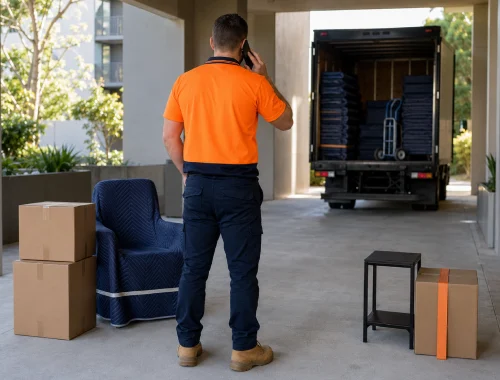
Changes can affect handling requirements, truck capacity, preparation time and the quoted arrangement. It is better to update the moving provider before the job than to leave the team to solve an unexpected change at the address.
Coordinate Keys and Property Access
Keys and access arrangements should be confirmed before moving day.
This is especially important for vacant properties, settlement-related moves, apartment buildings and jobs arranged by someone who will not be present.
Decide who will:
- Collect or release the keys
- Open gates and security doors
- Provide building access codes
- Meet the moving team
- Reserve lifts or loading areas
- Confirm possession of the property
- Lock the property after collection
- Provide access at the destination
A key being available somewhere nearby is not the same as having a confirmed access plan. The moving team needs clear instructions and a contact who can respond if access does not work as expected.
For settlement-related moves, possession and key availability should be confirmed through the appropriate authorised person. The moving booking should not depend on an uncertain assumption that keys will become available at an exact time.
Include Building Managers in the Plan
Apartment, unit and commercial property moves may require coordination with a building manager, reception team, facilities contact or body corporate representative.
The customer should find out whether the property has rules covering:
- Lift reservations
- Loading-bay bookings
- Basement access
- Truck-height restrictions
- Security doors
- Protective lift coverings
- Approved moving times
- Entry and exit procedures
- Parking or loading limits
The building contact may control access, but the customer remains responsible for communicating the confirmed arrangements to the moving provider.
Do not assume that a building manager will automatically meet the truck or direct the team. Confirm the person’s role and availability in advance.
Decide Who Approves Room Placement
The destination contact should know where every item belongs.
Clear room instructions help the moving team place furniture efficiently and reduce unnecessary rearranging after unloading.
Simple labels can identify destinations such as:
- Main bedroom
- Second bedroom
- Living room
- Upstairs office
- Garage
- Reception area
- Meeting room
- Storage room
When the person receiving the furniture is not authorised to make placement decisions, obtain those instructions from the main contact before delivery.
Photos or a basic room plan may help when furniture is being delivered to a vacant property, office, staged home or location managed by an agent.
The moving team provides physical furniture placement as agreed. It should not be expected to make styling, design or ownership decisions on behalf of absent contacts.
Share the Same Information with Everyone
Moving with multiple contacts works best when everyone receives the same confirmed information.
Before the move, send a simple summary containing:
- The scheduled date
- The collection and delivery addresses
- The authorised contacts
- The agreed inventory
- Access instructions
- Key arrangements
- Building requirements
- Expected item preparation
- Room-placement instructions
- The main contact’s phone number
Ask each contact to report changes to the main organiser rather than creating a separate arrangement directly with different people.
The moving provider should also be told about important updates. A changed pickup window, unavailable lift, missing key or additional collection point can affect the job plan.
Create a Backup Contact Plan
Even a carefully organised move may need a backup contact.
A phone may be unanswered, an agent may be delayed, or a building manager may become unavailable. Choose another authorised person who understands the arrangement and can help resolve access or placement questions.
The backup person should know:
- Which addresses are involved
- Who is expected at each location
- Where keys are held
- Which items are being moved
- Who can authorise decisions
- How to contact the main organiser
A backup plan should support the confirmed moving arrangement, not introduce new instructions at the last moment.
Keep Every Person Working from One Plan
Good coordination creates a clear chain of responsibility from collection to delivery.
Small Load Removalist can assess pre-booked moves involving separate sellers, property contacts, family members, agents, building managers and receiving contacts. Every enquiry is reviewed according to the items, access, route, preparation requirements and authorised contact arrangements.
We serve customers across Greater Brisbane, North Brisbane, Moreton Bay and the Sunshine Coast. Send us the complete item list, addresses, photographs, preferred date and contact details for each location. Our team will review the information and provide a suitable job-specific quote.