
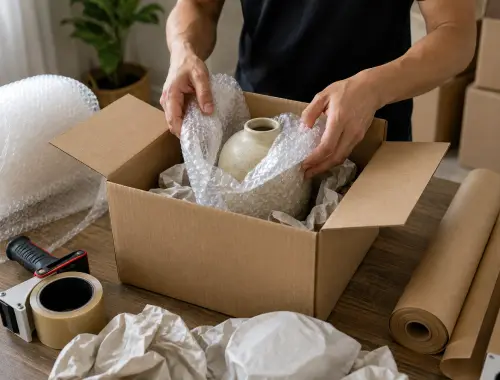
Packing Tips for a Smoother Brisbane Move
Use these practical packing tips for a smaller furniture or household move in Brisbane. Choose cartons for the contents, support fragile belongings, seal every box and label the destination room so the removalists can identify it at pickup and delivery. This guide covers packing your own boxes; if you need the team to pack items, arrange packing and unpacking assistance in advance as part of the assessed quote. The full moving preparation checklist covers appliances, building access, parking and arrival readiness.
Choose the Right Box for the Load
Choose a sturdy carton based on both the weight and size of its contents. Put books, tools and other dense items in smaller boxes; use larger boxes for cushions, linen and other light bulky belongings. Avoid mixing fragile pieces with heavy items or overfilling a carton until it bulges. You should be able to control the closed box without its bottom, sides or handles deforming. Boxes used for smaller household loads still need to be suitable for stacking and transport.
- Pack books, crockery and other dense contents in smaller boxes.
- Use larger cartons for linen, cushions and lightweight bulky items.
- Replace damp, crushed, torn or weakened boxes before packing.
- Divide a difficult load into two smaller boxes rather than forcing one heavy carton.
There is no universal safe maximum box weight. The strength of the carton, the belongings inside, the carrying route and the person handling it all matter. Follow any manufacturer’s load rating, and divide boxes that are too heavy, unstable or awkward. Do not assume the removalists can safely lift a carton simply because its tape or handles are holding. Disclose unusual weights so the team can assess lifting needs and moving equipment.
Small box
Books and dense items
Medium box
Mixed household items
Large box
Linen and light bulky items
Make Every Box Secure Before It Moves
Strong cartons work best when the base is properly formed, the contents are balanced and the top closes flat without bulging.
Build
Start with a clean, dry box in sound condition. Fold the base correctly and tape the centre seam and joining edges securely.
Fill
Distribute weight evenly. Fill unused spaces with suitable cushioning so the contents do not move excessively inside the carton.
Seal
Close the top flaps flat and tape the full seam. Avoid open-top, overflowing or loosely folded boxes that can release their contents.
Pack Fragile Items to Limit Movement
Fragile belongings need more than a ‘Fragile’ sticker. Wrap individual glass or ceramic pieces where practical, cushion the base and sides, separate hard surfaces and fill gaps so contents cannot strike each other. Use a carton suitable for the weight and close it without pressure on delicate items. Record the item condition and photograph valuable or previously damaged pieces. Insurance exclusions and consumer rights are explained separately; careful packing does not guarantee cover or prevent every possible damage event.
Wrap • Cushion • Separate
Keep breakable surfaces supported and reduce movement inside the carton.
- Wrap breakable pieces individually where practical.
- Add cushioning to the bottom, sides and top of the box.
- Keep heavier pieces below lighter pieces.
- Fill gaps without forcing pressure onto delicate contents.
- Close the carton fully and identify it as fragile.
Discuss unusual items first
High-value, unusually fragile, unstable or specialist items may need separate assessment. A fragile label does not make unsuitable packing safe or confirm that every item can be handled as an ordinary box.
Use Labels That Help at Both Addresses
Write enough information for the box to be recognised quickly. Place the label on more than one visible side where practical so it can still be read when cartons are stacked.
Destination room
Kitchen
Use the destination room, not only the room where the box was packed.
Contents
Everyday plates
Prefer a short useful description over labels such as “miscellaneous.”
Box number
4 of 8
A simple sequence makes it easier to notice when a carton is missing.
Handling note
Fragile
Use notes such as fragile, upright or open first only where relevant.
Keep Hardware and Cables Organised
Furniture fittings and device accessories are easy to misplace when they are left loose. Labelled groups make it clearer which parts belong together at the destination.
Furniture hardware
- Place screws, bolts, brackets and fittings in sealed bags.
- Write the furniture item and destination room on each bag.
- Keep assembly instructions with the matching hardware.
- Take reference photographs before complex disassembly where useful.
Cables, remotes and accessories
- Label which device each lead, adapter or remote belongs to.
- Coil cables without forcing sharp bends or leaving them trailing.
- Group stands, controls and removable parts in labelled containers.
- Photograph complicated connections before disconnecting equipment.
Separate assessment
Check Before Packing Specialist Items
Ordinary moving-box instructions may be unsuitable for artwork, antiques, high-value pieces, televisions, large glass, unstable furniture, unusually heavy objects or hazardous contents. Check acceptance and packing requirements before booking. Under the business’s stated insurance policy, televisions are not covered unless packed in suitable original manufacturer packaging; blankets are not an equivalent substitute. Artwork and antiques are excluded from standard cover. Keep cash, jewellery, important documents and other valuables with you, not in the moving cartons. Provide photographs and measurements for specialist items and ask about restrictions before treating them as part of the job.
01
High-value possessions
Provide clear item details and photographs for review.
02
Artwork and antiques
Do not assume ordinary cartons or materials are appropriate.
03
Large glass pieces
Measurements, construction and access need to be considered.
04
Delicate electronics
Use suitable packaging and disclose fragile or detachable parts.
05
Unusually heavy items
Provide the item’s dimensions, known weight, lifting points and access restrictions. A sturdy carton alone does not establish that an unusually heavy object can be moved safely.
06
Hazardous or leaking contents
Do not box leaking chemicals, unsecured fuels, pressurised or other potentially hazardous contents with household goods. Identify the item and ask whether it can be accepted; do not assume it is permitted.
Before You Call a Box Finished
Before closing each box, check that the bottom is secure, items are cushioned and balanced, the flaps close flat, and the destination room, short contents description and carton number are readable. Note fragile or upright handling only where relevant. Count the packed boxes and update the inventory if it has changed since the quote. The Moving Preparation Checklist covers access, appliances, pets, parking and the rest of moving-day readiness.
- The base is assembled and taped securely.
- The contents do not move excessively.
- The carton stays stable without bulging.
- The top closes flat and the seam is taped.
- The destination room is easy to see.
- The contents and box number are recorded.
- Fragile or orientation notes are visible.
- No loose hardware, cables or small parts remain unlabelled.
Packing Tips FAQs
These answers cover ordinary self-packing decisions. Specialist items and requested packing assistance still need to be discussed for the individual job.
There is no universal maximum that suits every box, person or access path. Use smaller cartons for dense contents and divide any box that becomes unstable, difficult to control or likely to fail at the base or sides.
Match the box size to the density of the contents, reinforce the base, fill unused space, close the top flat and tape the seams. Label the destination room, a short contents description, the box number and any relevant handling note.
Tell the team about unusually valuable, heavy, fragile, unstable, hazardous or specialist belongings before assuming ordinary packing is suitable. Artwork, antiques, large glass, delicate electronics and specialist equipment may need item-specific information and review.
Continue preparing
Related Moving Guidance
Use the guide or service page that matches the next part of your preparation.
Packing & Unpacking Services
See packing support that may be arranged in advance for the job.
Furniture Wrapping Services
See when furniture wrapping should be discussed before moving day.
Moving Preparation Checklist
Check inventory, appliance, access and arrival-readiness tasks.
Need Help With the Packing?
If you want help beyond packing your own cartons, explain which rooms or item groups need attention, how many fragile items are involved, what materials you already have, and whether packing or physical unpacking and furniture wrapping are required. These are assessed services, not automatically included with every move. You can request a job-specific quote or discuss your packing needs; an enquiry does not reserve a moving date.